NCERT Class 9 Science Notes English Medium
NCERT Class 9 Science – Exam Notes
Chapter 2 –
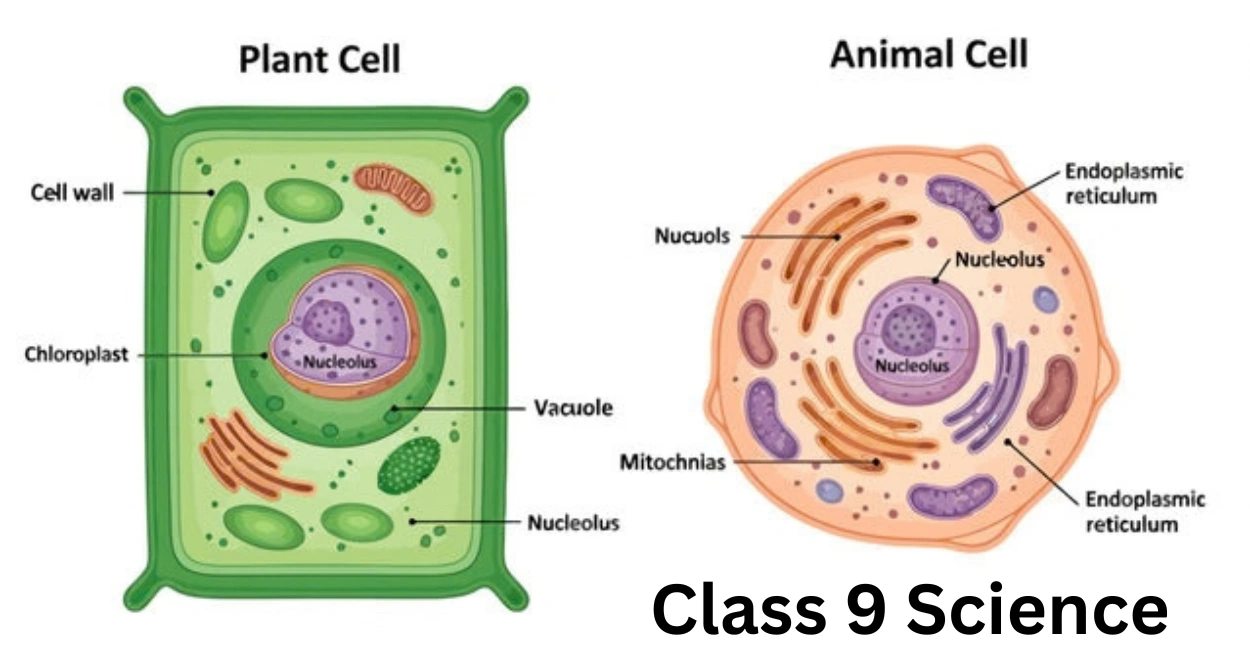
Cell: The Fundamental Unit of Life
What is a Cell?
Just as a house is made up of bricks, all living organisms are made up of cells.
A cell is the smallest structural and functional unit of life.
Examples
- Humans are made up of millions of cells.
- Plants are also made up of cells.
- Some bacteria consist of only one cell.
Who Discovered the Cell?
In about 1665, Robert Hooke observed a thin slice of cork through a microscope.
He saw many small, box-like structures and named them Cells.
Later, scientists studied living cells in detail.
Cell Theory
The main points of the Cell Theory are:
- All living organisms are made up of cells.
- The cell is the basic unit of life.
- New cells are formed from pre-existing cells.
Main Parts of a Cell:
A typical cell mainly has three important parts:
- Cell Membrane
- Cytoplasm
- Nucleus
1. Cell Membrane:
The cell membrane forms the outer boundary of the cell.
Functions
- Protects the cell.
- Controls the movement of substances into and out of the cell.
- It is selectively permeable, which means it allows only certain substances to pass through it.
2. Cytoplasm:
Cytoplasm is the jelly-like substance present between the cell membrane and the nucleus.
- Most of the cell organelles are present in the cytoplasm.
- Many important chemical reactions take place here.
3. Nucleus:
The nucleus is known as the control centre of the cell.
Functions
- Controls various activities of the cell.
- Contains the cell’s genetic material (DNA).
- Helps in the transmission of hereditary information.
Cell Organelles:
Cell organelles are specialised structures inside a cell that perform specific functions.
1. Mitochondria:
Mitochondria are called the powerhouses of the cell.
Function
- They release energy from food.
- This energy is used for various activities of the cell.
2. Ribosomes:
Function
- Ribosomes are responsible for protein synthesis.
- They make proteins needed by the cell.
3. Golgi Apparatus:
Functions
- Modifies and packages substances.
- Helps in transporting substances to different parts of the cell or outside the cell.
4. Endoplasmic Reticulum (ER):
There are two main types:
RER – Rough Endoplasmic Reticulum
- Has ribosomes attached to its surface.
- Helps mainly in protein-related activities.
SER – Smooth Endoplasmic Reticulum
- Does not have ribosomes.
- Helps in the formation of certain fats and other substances.
5. Lysosomes:
Lysosomes contain substances that help break down waste materials and unwanted cell components.
Functions
- Break down damaged cell organelles.
- Help in cleaning the cell.
Easy way to remember:
Lysosomes are like the cleaning staff of the cell.
6. Chloroplast:
Chloroplasts are found mainly in plant cells.
They contain a green pigment called chlorophyll.
Function
- Chloroplasts help plants make food by photosynthesis using sunlight.
7. Vacuole:
Vacuoles are storage structures inside cells.
Functions
- Store water.
- Store food and other substances.
- Plant cells usually have a large central vacuole.
- Animal cells usually have small vacuoles, if present.
Plant Cell vs Animal Cell
| Plant Cell | Animal Cell |
|---|---|
| Cell wall is present | Cell wall is absent |
| Chloroplasts are present in
photosynthetic plant cells |
Chloroplasts are absent |
| Usually has a large central vacuole | Usually has small vacuoles |
| Shape is generally more fixed | Shape can be more variable |
Important MCQs
1. What is the basic unit of life?
A. Tissue
B. Organ
C. Cell
D. Organism
Answer: C. Cell
2. Who discovered the cell?
A. Newton
B. Robert Hooke
C. Darwin
D. Einstein
Answer: B. Robert Hooke
3. Which organelle is called the powerhouse of the cell?
A. Nucleus
B. Mitochondria
C. Vacuole
D. Golgi apparatus
Answer: B. Mitochondria
4. Chloroplasts are mainly found in:
A. Animal cells
B. Plant cells
C. Bacteria
D. Viruses
Answer: B. Plant cells
2-Minute Revision
- Cell = Basic unit of life.
- Cell discovered by = Robert Hooke.
- Nucleus = Control centre of the cell.
- Mitochondria = Powerhouse of the cell.
- Ribosomes = Protein synthesis.
- Golgi apparatus = Modification and packaging.
- Chloroplast = Photosynthesis.
- Plant cell = Cell wall + chloroplasts + large central vacuole.
- Osmosis = Movement of water through a selectively permeable membrane.
- Diffusion = Movement of particles from a region of higher concentration to a region of lower concentration.
NCERT Class 9 Science – Exam Notes
Chapter 3 –
Tissues in Action
Introduction
If every cell in our body had to perform every function, the body would not work efficiently.
Therefore, cells with similar structures and functions work together to form tissues.
For example:
- Muscle cells together form muscle tissue.
- Nerve cells form nervous tissue.
- Plants also have different types of tissues for different functions.
Thus, tissues make the working of the body easier and more efficient.
What is a Tissue?
Definition
A tissue is a group of cells that have a similar structure and perform a similar function.
Easy Example – Cricket Team
Think of a cricket team:
- Batsmen mainly do batting.
- Bowlers mainly do bowling.
- The wicketkeeper looks after the wicket.
Similarly, different tissues in the body perform different specialised functions.
Why Do We Need Tissues?
If every cell performed all functions on its own, the body would work slowly and inefficiently.
Formation of tissues helps in:
- Faster performance of functions.
- Greater efficiency.
- Saving energy.
- Performing specialised functions easily.
Plant Tissues
Plants mainly have two broad types of tissues:
- Meristematic Tissue
- Permanent Tissue
1. Meristematic Tissue
Definition
Meristematic tissues consist of cells that actively divide and produce new cells.
Functions
- Increase the length of the plant.
- Increase the thickness of stems and roots.
- Produce new branches and leaves.
Types of Meristematic Tissue
1. Apical Meristem
Location
- At the tips of roots.
- At the growing tips of shoots.
Function
- Increases the length of the plant.
2. Lateral Meristem
Location
- Along the sides of stems and roots.
Function
- Increases the thickness or girth of stems and roots.
3. Intercalary Meristem
Location
- Near the nodes or at the bases of leaves, especially in grasses.
Function
- Helps plants such as grasses grow rapidly.
- Helps in regrowth after cutting or grazing.
Characteristics of Meristematic Tissue
- Cells are living.
- Cells divide continuously.
- Cells are closely packed.
- There are very few or no intercellular spaces.
- Cell walls are generally thin.
2. Permanent Tissue
When meristematic cells stop dividing and become specialised for particular functions, they form permanent tissues.
Permanent tissues are mainly of two types:
- Simple Permanent Tissue
- Complex Permanent Tissue
Simple Permanent Tissue
The main types are:
- Parenchyma
- Collenchyma
- Sclerenchyma
1. Parenchyma
Functions
- Stores food.
- In some plant parts, helps in photosynthesis.
- Helps in healing and repair of injured parts.
2. Collenchyma
Function
- Provides flexibility and support to plant parts.
- Allows plant parts such as young stems and leaves to bend without breaking easily.
3. Sclerenchyma
Function
- Provides strength and mechanical support to the plant.
The cells are generally thick-walled and provide rigidity.
Complex Permanent Tissue
The two main complex tissues are:
- Xylem
- Phloem
Xylem
Function
Xylem transports water and minerals from the roots to other parts of the plant.
Easy Trick
Xylem = Water
Phloem
Function
Phloem transports food prepared by the leaves to different parts of the plant.
Easy Trick
Phloem = Food
Animal Tissues
Animals have four main types of tissues:
- Epithelial Tissue
- Connective Tissue
- Muscular Tissue
- Nervous Tissue
1. Epithelial Tissue
Epithelial tissue covers the outer surface of the body and also lines many internal organs.
Functions
- Protection.
- Absorption.
- Secretion.
Examples
- Skin.
- Lining of the mouth.
- Lining of the intestine.
Easy Trick
Epithelial = Covering and Protection
2. Connective Tissue
Connective tissue connects, supports or binds different parts of the body.
Examples
- Blood.
- Bone.
- Cartilage.
- Tendons.
- Ligaments.
Functions
- Provides support.
- Connects body parts.
- Helps in transport and nourishment.
Easy Trick
Connective = Connecting
3. Muscular Tissue
Muscular tissue helps produce movement in the body.
There are three important types:
1. Voluntary Muscles
These muscles work according to our will.
Examples
- Muscles of arms.
- Muscles of legs.
2. Involuntary Muscles
These muscles work automatically and are not under our conscious control.
Examples
- Muscles of the stomach.
- Muscles of the intestine.
3. Cardiac Muscle
- Found only in the heart.
- Works continuously throughout life.
- Helps the heart pump blood.
Easy Trick
Muscular Tissue = Movement
4. Nervous Tissue
Nervous tissue helps in the transmission of messages in the body.
Main Cell
Neuron
Functions
- Carries messages between the brain and different parts of the body.
- Helps the body respond to changes or stimuli.
Easy Trick
Nervous Tissue = Messages
Musculoskeletal System
Our body does not move with the help of bones alone.
Bones + Muscles + Joints = Musculoskeletal System
Together, they help the body move.
Functions of Bones
Bones help to:
- Give shape and support to the body.
- Protect internal organs.
- Help in movement.
- Store minerals such as calcium.
- Support the body.
Types of Joints
A joint is the place where two or more bones meet.
1. Fixed Joint
There is little or no movement at these joints.
Example
- Bones of the skull.
2. Movable Joints
These joints allow movement.
A. Ball-and-Socket Joint
Allows movement in many directions.
Examples
- Shoulder.
- Hip.
B. Hinge Joint
Allows movement mainly in one direction.
Examples
- Knee.
- Elbow.
C. Pivot Joint
Allows rotational movement.
Example
- Neck.
D. Gliding Joint
Allows bones to slide over one another.
Example
- Wrist.
Correct Body Posture
Correct posture helps keep the spine and muscles healthy.
Good Posture Habits
✔ Sit straight.
✔ Do not bend too much while studying.
✔ Carry a heavy school bag using both shoulders.
✔ Do not bend your neck excessively while using a mobile phone.
Why is Exercise Important?
Regular exercise helps:
- Strengthen bones.
- Strengthen muscles.
- Keep the body flexible.
- Maintain a healthy body weight.
- Improve overall physical fitness.
How to Take Care of Bones
- Eat calcium-rich foods.
- Get sufficient Vitamin D.
- Spend some time in sunlight as appropriate.
- Exercise regularly.
- Take precautions to avoid falls and injuries.
Important Facts for Examination
✔ Tissue = Group of cells performing similar functions.
✔ Meristematic tissue = Helps in plant growth.
✔ Xylem = Transports water and minerals.
✔ Phloem = Transports food.
✔ Epithelial tissue = Protection and covering.
✔ Connective tissue = Connects and supports body parts.
✔ Muscular tissue = Produces movement.
✔ Nervous tissue = Carries messages.
✔ Bones + Muscles + Joints = Help in body movement.
✔ Correct posture + Balanced diet + Regular exercise = Important for a healthy musculoskeletal system.
Chapter Summary
Plants and animals have different types of tissues, and each tissue performs a specific function.
In plants:
- Meristematic tissues help in growth.
- Permanent tissues perform specialised functions.
- Xylem transports water and minerals.
- Phloem transports food.
In animals:
- Epithelial tissue provides protection and covering.
- Connective tissue connects and supports different body parts.
- Muscular tissue produces movement.
- Nervous tissue carries messages.
Bones, muscles and joints work together to produce body movement.
Correct posture, a balanced diet and regular exercise help maintain a healthy musculoskeletal system.
2-Minute Revision
Plant Tissues
Meristematic → Growth
Parenchyma → Storage / Photosynthesis
Collenchyma → Flexibility
Sclerenchyma → Strength
Xylem → Water
Phloem → Food
Animal Tissues
Epithelial → Protection
Connective → Connecting & Support
Muscular → Movement
Nervous → Messages
Musculoskeletal System
Bones + Muscles + Joints → Movement
Joint Examples:
Ball & Socket → Shoulder, Hip
Hinge → Knee, Elbow
Pivot → Neck
Gliding → Wrist
Remember:
Xylem = Water
Phloem = Food
Muscle = Movement
Neuron = Message
Epithelial = Protection